How to homeschool in Florida
Most Florida families file a short notice of intent with their county school superintendent, keep a portfolio, and turn in one evaluation of progress each year. The evaluation can be a certified teacher's portfolio review, a standardized test, or one of a few other methods you choose. Some families instead enroll in a private school (often an "umbrella" school) that keeps the records.
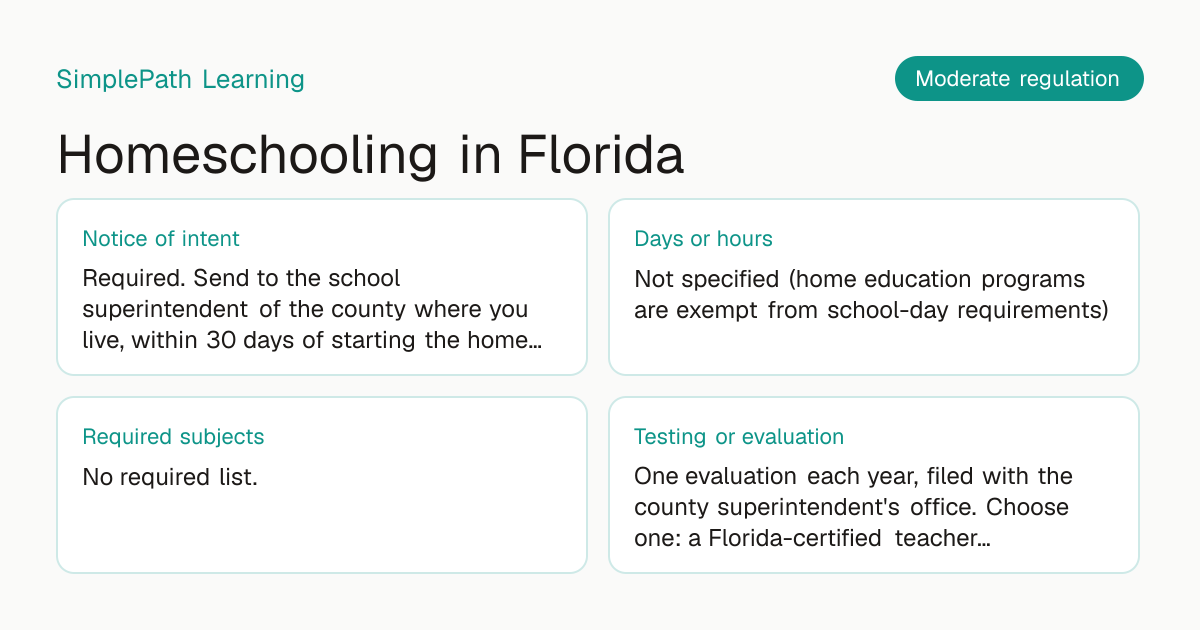
Option 1: Home education program
The option most families use.
Home education program · Fla. Stat. § 1002.41
The parent registers a home education program with the county school superintendent and directs the child's education. No teaching certificate is needed. The parent keeps a portfolio and files an annual evaluation with the district.
- Notice
- Send to: the school superintendent of the county where you live.
- When: within 30 days of starting the home education program.
- How often: once (file a separate notice of termination when the program ends).
- How: a written notice signed by the parent; many county home education offices also accept it through an online form.
- Instruction time
- Not specified (home education programs are exempt from school-day requirements).
- Records to keep
- A log of educational activities, made at the time of instruction, listing reading materials by title.
- Samples of the student's writings, worksheets, workbooks, or creative materials.
- Keep the portfolio for 2 years and make it available to the superintendent within 15 days of a written request.
- Testing / evaluation
- One evaluation each year, filed with the county superintendent's office. Choose one: a Florida-certified teacher reviews the portfolio and talks with the student; a nationally normed achievement test given by a certified teacher; a state student assessment given by a certified teacher at an approved location; an evaluation by a licensed psychologist; or another valid tool agreed on by the parent and superintendent. If progress is not adequate, the parent gets a one-year probation period to provide remedial instruction.
- Parent qualifications
- None for the parent (the evaluator, if you use the teacher-review option, must hold a Florida teaching certificate).
- Also
- The district may not require information beyond the notice unless your child joins a district program or service.
- File a written notice of termination with the superintendent within 30 days of ending the program, along with the annual evaluation.
What the notice must include
- Full legal name of each child to be enrolled.
- Address of each child.
- Birthdate of each child.
- Parent's signature.
Checklist
- Withdraw your child from their current school in writing (if enrolled): before starting the home education program.
- File notice of intent with the county school superintendent: within 30 days of starting.
- Keep the portfolio (activity log with reading titles + work samples): ongoing; keep each year's portfolio for 2 years.
- File the annual evaluation with the county superintendent's office: each year (most districts treat the due date as the anniversary of your notice of intent).
- File notice of termination plus a final annual evaluation: within 30 days of ending the program.
Option 2: Enroll in a private school (including umbrella/home-study private schools)
Enroll in a private school (including umbrella/home-study private schools) · Fla. Stat. § 1002.42
The child enrolls in a private school, which may let families teach at home under its supervision. The private school, not the family, keeps attendance records and files the school's annual survey with the Florida Department of Education.
- Notice
- Not required.
- Instruction time
- Set by the private school.
- Records to keep
- Whatever the private school requires; the school keeps official attendance records.
- Testing / evaluation
- Set by the private school; no state evaluation is filed for the family.
- Parent qualifications
- Set by the private school.
Checklist
- Withdraw your child from their current school in writing (if enrolled): before enrolling in the private school.
- Enroll with the private school and follow its reporting rules: each school year.
Option 3: Private tutor
Private tutor · Fla. Stat. § 1002.43
A tutor who holds a valid Florida teaching certificate for the subjects or grades taught instructs the child. This option is rarely used because the tutor must be certified and keep state attendance records.
- Notice
- Not required.
- Instruction time
- The minimum time set for public schools under Fla. Stat. § 1011.60(2).
- Records to keep
- Attendance and other records required by the state and district school board (kept by the tutor).
- Parent qualifications
- Tutor must hold a valid Florida teaching certificate for the subjects or grades taught.
- Also
- The tutor makes regular attendance reports as required by Fla. Stat. § 1003.23(2).
Checklist
- Confirm the tutor holds a valid Florida teaching certificate for the grades/subjects taught: before instruction begins.
- Tutor keeps and reports attendance records: ongoing.
Leaving a public school
If your child is enrolled in a public or private school, withdraw in writing before starting a home education program; districts typically date your enrollment from the day they receive the notice of intent and do not backdate it.
Common questions about homeschooling in Florida
- Do I have to notify anyone to homeschool in Florida?
- Yes (for home education program, the option most families use). You send notice to the school superintendent of the county where you live, within 30 days of starting the home education program. How often: once (file a separate notice of termination when the program ends). A written notice signed by the parent; many county home education offices also accept it through an online form.
- What subjects do I have to teach in Florida?
- Florida doesn't set a required subject list (for home education program, the option most families use). Most families still cover reading, writing, math, science and social studies.
- How many days or hours of homeschool does Florida require?
- Not specified (home education programs are exempt from school-day requirements).
- Are standardized tests or evaluations required in Florida?
- One evaluation each year, filed with the county superintendent's office. Choose one: a Florida-certified teacher reviews the portfolio and talks with the student; a nationally normed achievement test given by a certified teacher; a state student assessment given by a certified teacher at an approved location; an evaluation by a licensed psychologist; or another valid tool agreed on by the parent and superintendent. If progress is not adequate, the parent gets a one-year probation period to provide remedial instruction.
- Do parents need a teaching certificate to homeschool in Florida?
- None for the parent (the evaluator, if you use the teacher-review option, must hold a Florida teaching certificate).
- What records should I keep when homeschooling in Florida?
- A log of educational activities, made at the time of instruction, listing reading materials by title; Samples of the student's writings, worksheets, workbooks, or creative materials; Keep the portfolio for 2 years and make it available to the superintendent within 15 days of a written request.
Worth double-checking
- The statute says the evaluation is filed "annually" without naming a date. Districts (e.g. Miami-Dade, Monroe) treat it as due on the anniversary of your notice of intent; check your county's home education office for its exact rule.
- Since July 1, 2023 (HB 1), Florida also offers the Personalized Education Program (PEP), an education savings account for home-educated students funded through the Florida Tax Credit Scholarship. PEP families register through a Scholarship Funding Organization (e.g. Step Up For Students) rather than the district home education office, and enrollment is capped each year. Check current eligibility, caps, and testing rules with the scholarship organization.
- Families using an umbrella private school should confirm the school has filed its annual survey with the Florida Department of Education.
- The Florida Department of Education's home education page could not be retrieved during this check; details were confirmed against the statute and county district pages.
Sources
- Fla. Stat. § 1002.41 Home education programs (Florida Senate).(official)
- Fla. Stat. § 1002.42 Private schools (Florida Senate).(official)
- Fla. Stat. § 1002.43 Private tutoring programs (Florida Senate).(official)
- Florida Senate bill summary, 2023 HB 1 (Personalized Education Program).(official)
- Palm Beach County School District home education FAQ.(official)
- Lee County Schools: annual evaluation / portfolio requirements.(official)
This is a plain-language summary to help you get organized, not legal advice. Laws and forms change, so confirm the details with your state or school district before you file.