How to homeschool in North Dakota
In North Dakota you file a Statement of Intent with your local superintendent every year, at least 5 days before you start. You teach the subjects public schools teach for at least 4 hours a day, 175 days a year, and keep a yearly record of courses and progress. Children take a standardized test in grades 4, 6, 8, and 10 unless you qualify for an exemption (including a philosophical, moral, or religious objection).
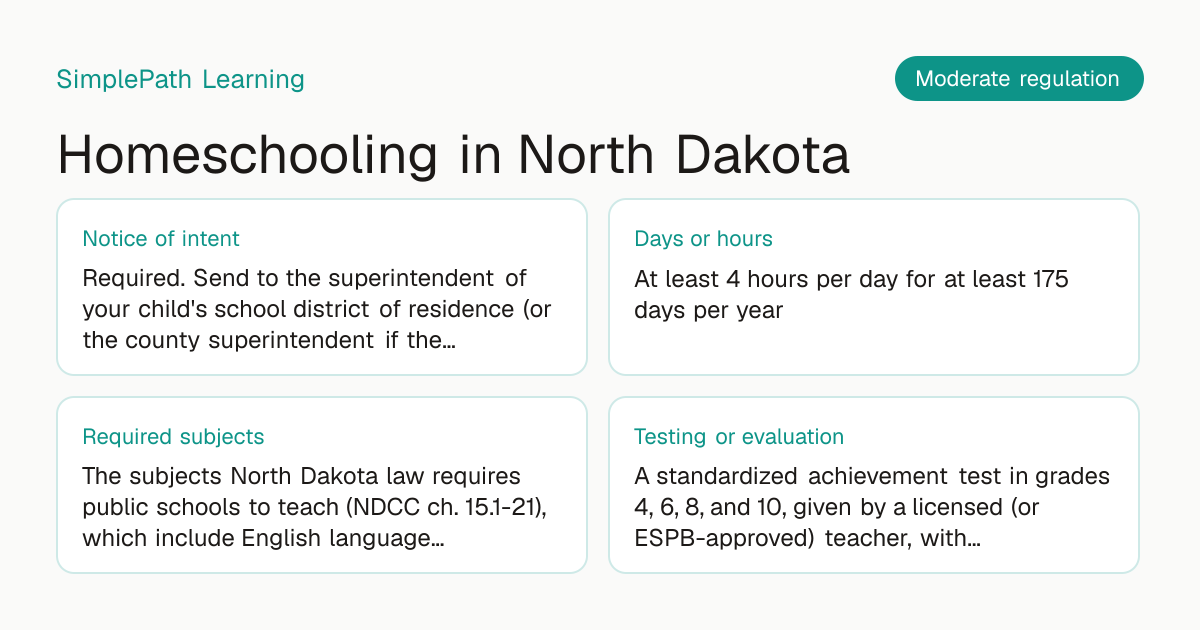
Requirements in North Dakota
Home education (Statement of Intent) · N.D. Cent. Code ch. 15.1-23
A parent supervises the child's education at home and files an annual Statement of Intent with the local superintendent. A parent with a high school diploma or GED needs no monitoring; a parent without one must be monitored by a licensed teacher for the first two years.
- Notice
- Send to: the superintendent of your child's school district of residence (or the county superintendent if the district has no superintendent).
- When: at least 5 days before beginning home education, or within 14 days of moving into a school district.
- How often: annually (one form per child).
- How: file the state's Statement of Intent form (SFN 16909) with attachments; certified mail with return receipt is a good way to keep proof.
- Instruction time
- At least 4 hours per day for at least 175 days per year.
- Required subjects
- The subjects North Dakota law requires public schools to teach (NDCC ch. 15.1-21), which include English language arts, mathematics, science, social studies (including U.S. and North Dakota history and government), health, and physical education.
- Records to keep
- An annual record of courses taken.
- The child's academic progress assessments, including any standardized test results (give them to the district on request if the child transfers to public school).
- Testing / evaluation
- A standardized achievement test in grades 4, 6, 8, and 10, given by a licensed (or ESPB-approved) teacher, with results filed with the superintendent. Exempt if, when you file your Statement of Intent, you notify the district of a philosophical, moral, or religious objection, or document that you hold a teaching license, a bachelor's degree, or a passing national teacher exam score. A composite below the 30th percentile triggers a learning assessment and possibly a remediation plan.
- Parent qualifications
- High school diploma or GED; otherwise the parent must be monitored by a licensed teacher for the first two years (longer if test scores are below the 50th percentile).
- Also
- Compulsory attendance ages are 7 to 16.
- Monitors meet with the family about one hour per week and report progress to the superintendent twice a year.
- Children with a developmental disability have additional filing and progress-report requirements (§§ 15.1-23-14 and -15).
Official form: ND Department of Public Instruction: Statement of Intent to Supervise Home Education (SFN 16909)
What the notice must include
- The child's name, address, date of birth, and grade level.
- The supervising parent's name, address, and qualifications (attach a copy of your diploma or GED).
- Any public school courses the child will take and the district offering them.
- Any extracurricular activities the child will join and the district or approved nonpublic school offering them.
- A copy of the child's immunization record.
- Proof of the child's identity.
- If claiming a testing exemption: notice of the exemption and supporting documentation.
- If monitoring is required: who will monitor (district-provided or a licensed teacher you select).
Checklist
- File your Statement of Intent (SFN 16909) with the local superintendent: at least 5 days before starting, and every year.
- Attach immunization record, proof of identity, and your diploma/GED copy: with your Statement of Intent.
- File a testing exemption, if you qualify: at the same time as your Statement of Intent.
- Arrange the standardized test and file results with the superintendent: in grades 4, 6, 8, and 10 (unless exempt).
- Keep an annual record of courses and academic progress: ongoing.
- Teach at least 4 hours/day for 175 days: each school year.
Leaving a public school
File your Statement of Intent with the superintendent at least 5 days before you begin home education; letting the school know in writing that you are withdrawing is a sensible extra step.
Common questions about homeschooling in North Dakota
- Do I have to notify anyone to homeschool in North Dakota?
- Yes. You send notice to the superintendent of your child's school district of residence (or the county superintendent if the district has no superintendent), at least 5 days before beginning home education, or within 14 days of moving into a school district. How often: annually (one form per child). File the state's Statement of Intent form (SFN 16909) with attachments; certified mail with return receipt is a good way to keep proof.
- What subjects do I have to teach in North Dakota?
- North Dakota requires: The subjects North Dakota law requires public schools to teach (NDCC ch. 15.1-21), which include English language arts, mathematics, science, social studies (including U.S. and North Dakota history and government), health, and physical education.
- How many days or hours of homeschool does North Dakota require?
- At least 4 hours per day for at least 175 days per year.
- Are standardized tests or evaluations required in North Dakota?
- A standardized achievement test in grades 4, 6, 8, and 10, given by a licensed (or ESPB-approved) teacher, with results filed with the superintendent. Exempt if, when you file your Statement of Intent, you notify the district of a philosophical, moral, or religious objection, or document that you hold a teaching license, a bachelor's degree, or a passing national teacher exam score. A composite below the 30th percentile triggers a learning assessment and possibly a remediation plan.
- Do parents need a teaching certificate to homeschool in North Dakota?
- High school diploma or GED; otherwise the parent must be monitored by a licensed teacher for the first two years (longer if test scores are below the 50th percentile).
- What records should I keep when homeschooling in North Dakota?
- An annual record of courses taken; The child's academic progress assessments, including any standardized test results (give them to the district on request if the child transfers to public school).
Worth double-checking
- The filing deadline is now 5 days before starting (older guides and some county forms still say 14 days).
- The required-subjects list is not spelled out in the home education chapter; it points to the subjects required of public schools. The list given here is a summary; check NDCC ch. 15.1-21 for the full grade-level list.
- North Dakota also allows a licensed teacher to teach their children as an approved nonpublic school; that route is uncommon and not covered here.
- We could not find a current ND DPI home education web page (the old URL returns 'page not found'); the statute and SFN 16909 form are the primary sources used.
Sources
- N.D. Cent. Code ch. 15.1-23 (Home Education).(official)
- ND DPI form SFN 16909: Statement of Intent to Supervise Home Education.(official)
- HSLDA: North Dakota.
This is a plain-language summary to help you get organized, not legal advice. Laws and forms change, so confirm the details with your state or school district before you file.