How to homeschool in South Carolina
South Carolina gives you three legal ways to homeschool, and every one requires 180 days of instruction and a parent with at least a high school diploma or GED. Most families join a homeschool accountability association (Option 3). You keep a plan book, portfolio and semiannual progress reports, and the association reports to your district. Option 1, where your school district board approves your program, adds state testing and reports to the district.
Option 1: Option 3: Homeschool accountability association
The option most families use.
Option 3: Homeschool accountability association · S.C. Code § 59-65-47
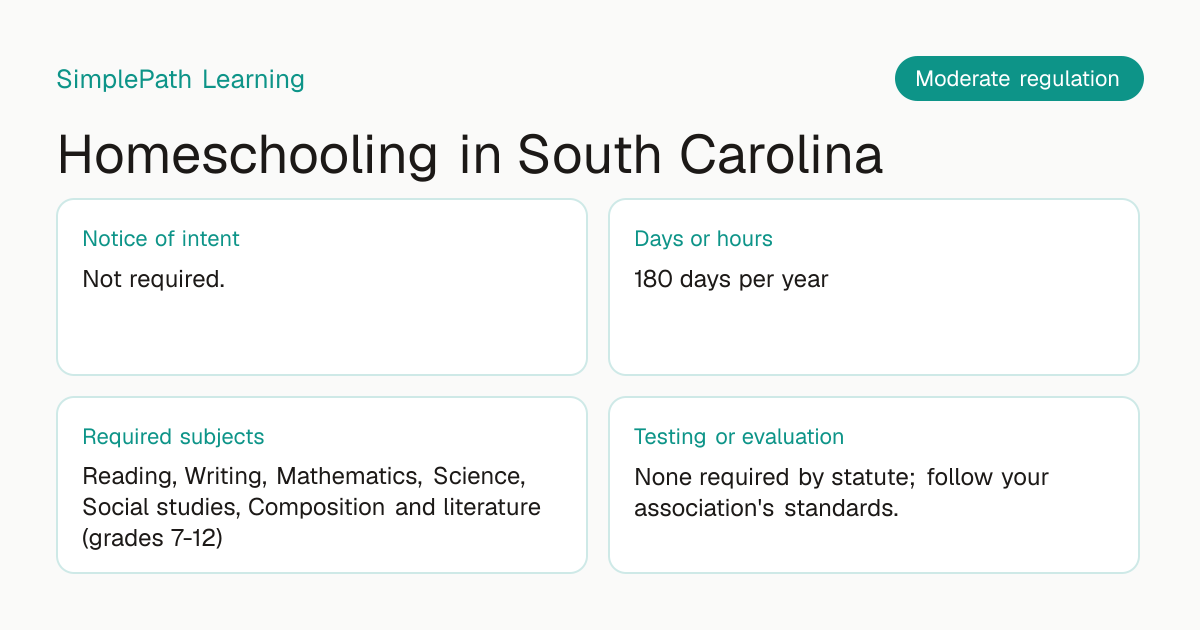
You teach at home as a member in good standing of a homeschool association with at least 50 members whose standards the state reviews each year. The association, not the school district, oversees your compliance. This is the option most South Carolina homeschoolers use.
- Notice
- Not required.
- Instruction time
- 180 days per year.
- Required subjects
- Reading, Writing, Mathematics, Science, Social studies, Composition and literature (grades 7-12).
- Records to keep
- Plan book, diary, or other record of subjects taught and activities.
- Portfolio of samples of the student's academic work.
- Semiannual progress report including attendance records and documentation of progress in each required subject.
- Testing / evaluation
- None required by statute; follow your association's standards.
- Parent qualifications
- Parent must have at least a high school diploma or GED.
- Also
- Compulsory attendance runs from the school year a child turns 5 before September 1 until age 17 or high school graduation; a parent may opt out of kindergarten if the child is not 6 by September 1 by signing the district's written election form.
- Use an association on the South Carolina Department of Education's current Option 3 list. Students in an association do not receive a state high school diploma.
Checklist
- Join an approved Option 3 association: before you start homeschooling, and renew each year.
- Give your child's school proof of association membership when withdrawing: when you withdraw.
- Keep a plan book and portfolio of work samples: ongoing.
- Complete semiannual progress reports with attendance: twice a year.
Option 2: Option 2: South Carolina Association of Independent Home Schools (SCAIHS)
Option 2: South Carolina Association of Independent Home Schools (SCAIHS) · S.C. Code § 59-65-45
You teach at home under the auspices of SCAIHS, which sets academic standards and oversight. Bona fide membership and continuing compliance with SCAIHS standards replace the district approval process.
- Notice
- Not required.
- Instruction time
- 180 days per year.
- Required subjects
- Reading, Writing, Mathematics, Science, Social studies, Composition and literature (grades 7-12).
- Testing / evaluation
- As required by SCAIHS standards.
- Parent qualifications
- Parent must have at least a high school diploma or GED.
Checklist
- Apply for and maintain SCAIHS membership: before you start homeschooling, and each year.
- Give your child's school proof of SCAIHS membership when withdrawing: when you withdraw.
- Meet SCAIHS reporting and testing requirements: per SCAIHS schedule.
Option 3: Option 1: School district approved home school
Option 1: School district approved home school · S.C. Code § 59-65-40
Your local school district board of trustees approves your home school program. The board must approve programs that meet the statute's standards, but this option has the most testing and reporting.
- Notice
- Send to: the board of trustees of your school district.
- When: before you begin; the district must tell you the date, time and place of the board meeting where your application is considered.
- How: the district's home school application.
- Instruction time
- At least 4.5 hours per day (excluding lunch and recess) and 180 days per year.
- Required subjects
- Reading, Writing, Mathematics, Science, Social studies, Composition and literature (grades 7-12).
- Records to keep
- Plan book, diary, or other written record of subjects taught and activities.
- Portfolio of samples of the student's academic work.
- Record of evaluations of the student's academic progress.
- Testing / evaluation
- Students take the annual statewide tests for their grade, given by a certified district employee (with public school students, or at home at the parent's expense). Children eligible for first grade take a readiness test in the first 15 instructional days. Scoring below the promotion standard for a year lets the board decide on placement, services, or homeschooling with support at parent expense.
- Parent qualifications
- Parent must have a high school diploma or GED (the statute also references a basic skills test), or a bachelor's degree.
- Also
- Students must have access to library facilities.
- If the district finds deficiencies, you have 30 days to correct them before approval can be withdrawn. A denial can be appealed to the State Board of Education within 10 days.
What the notice must include
- Description of the program.
- Texts and materials to be used.
- Methods of program evaluation.
- Place of instruction.
- Evidence of the parent's high school diploma/GED or bachelor's degree.
- Written agreement holding the district, its board and employees harmless for educational deficiencies resulting from home instruction.
Checklist
- Submit home school application to the district board of trustees: before you begin homeschooling.
- Submit semiannual progress report with attendance to the district: twice a year.
- Statewide testing: each year, on the state testing schedule.
- Keep plan book, portfolio and evaluation records for inspection: ongoing.
Leaving a public school
When withdrawing from public school, the district accepts as proof of homeschooling: the district's approval letter (Option 1), SCAIHS membership documentation (Option 2), or membership documentation from an association with at least 50 members (Option 3). Other documents are not accepted.
Common questions about homeschooling in South Carolina
- Do I have to notify anyone to homeschool in South Carolina?
- No (for option 3: homeschool accountability association, the option most families use). South Carolina doesn't require a notice of intent for this option. If your child is enrolled in a public school, withdraw them in writing first.
- What subjects do I have to teach in South Carolina?
- South Carolina requires: Reading; Writing; Mathematics; Science; Social studies; Composition and literature (grades 7-12).
- How many days or hours of homeschool does South Carolina require?
- 180 days per year.
- Are standardized tests or evaluations required in South Carolina?
- None required by statute; follow your association's standards.
- Do parents need a teaching certificate to homeschool in South Carolina?
- Parent must have at least a high school diploma or GED.
- What records should I keep when homeschooling in South Carolina?
- Plan book, diary, or other record of subjects taught and activities; Portfolio of samples of the student's academic work; Semiannual progress report including attendance records and documentation of progress in each required subject.
Worth double-checking
- Associations set their own fees, deadlines and extra rules (some require testing); read your association's requirements.
- Option 1's statute still mentions a parent basic skills exam; whether one is actually given was not confirmed. Ask your district.
- Foster parents need approval from the Department of Social Services (or the custodial agency) before homeschooling a foster child (§ 59-65-46).
Sources
- S.C. Code Title 59, Chapter 65 (§§ 59-65-10, -40, -45, -47).(official)
- SC Department of Education: Home School Option 3 associations.(official)
- SC Department of Education memo: Home School Documentation, Evidence of Transfer (Dec. 13, 2022).(official)
This is a plain-language summary to help you get organized, not legal advice. Laws and forms change, so confirm the details with your state or school district before you file.