How to homeschool in Virginia
Most Virginia families homeschool under the home instruction law. Each year you send your school division superintendent a notice of intent by August 15, along with a list of subjects and proof that you qualify (a high school diploma is enough). By August 1 after each year you send proof of progress: a test score or an evaluation. Families with a religious objection to school can instead ask the school board for a religious exemption, and a parent with a Virginia teaching license can teach as an approved tutor.
Option 1: Home instruction (notice of intent)
The option most families use.
Home instruction (notice of intent) · Va. Code § 22.1-254.1
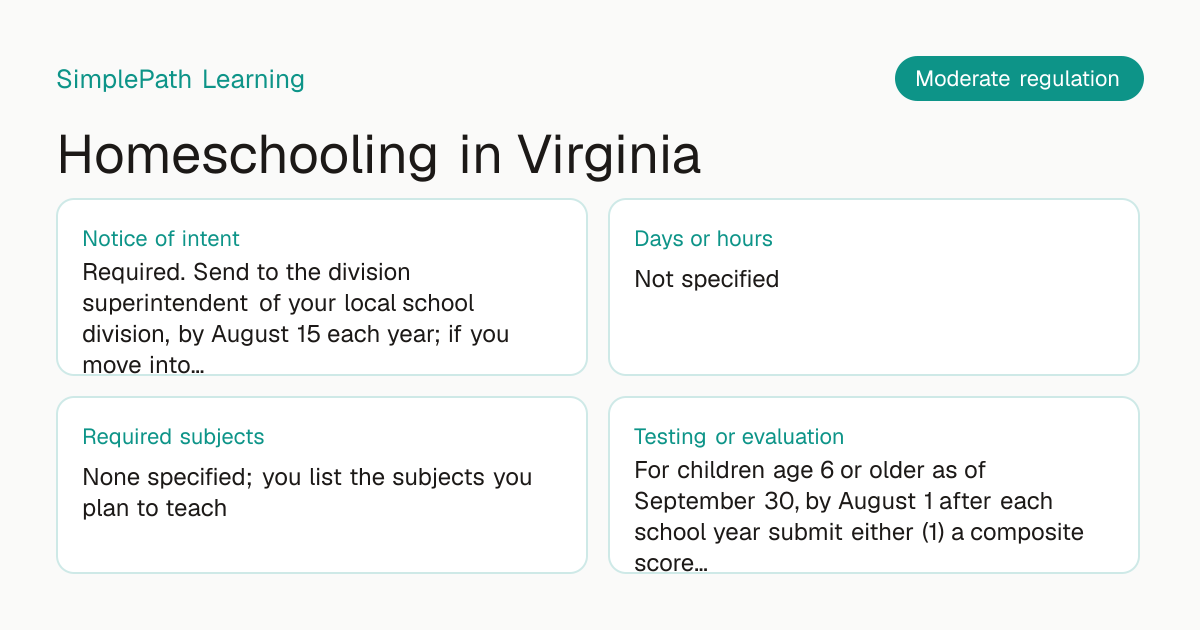
The most common option. You file an annual notice of intent with your local school division and then show evidence of your child's progress after each school year. The division cannot approve or reject your curriculum.
- Notice
- Send to: the division superintendent of your local school division.
- When: by August 15 each year; if you move into the division or start after the school year has begun, notify as soon as practicable and meet the remaining requirements within 30 days.
- How often: annually.
- How: any written format and delivery method; many divisions offer their own form, and VDOE publishes a sample.
- Instruction time
- Not specified.
- Required subjects
- None specified; you list the subjects you plan to teach.
- Records to keep
- Copies of each year's notice of intent and attachments.
- Each year's test results or evaluation letter.
- Testing / evaluation
- For children age 6 or older as of September 30, by August 1 after each school year submit either (1) a composite score at or above the 4th stanine on a nationally normed standardized achievement test, or an equivalent ACT, SAT, or PSAT score, or (2) an evaluation the superintendent finds shows adequate progress, such as a letter from a person licensed to teach in any state or holding a master's degree or higher in an academic discipline who knows the child's progress, or a report card or transcript from a college, college distance-learning program, or home-education correspondence school. Without adequate evidence the program may be placed on one year of probation with a remediation plan.
- Parent qualifications
- One of: a high school diploma; teacher qualifications set by the Board of Education; a correspondence, distance-learning, or other program of study or curriculum; or evidence that you can provide an adequate education.
Official form: VDOE Home Instruction page (Sample Notice of Intent to Provide Home Instruction)
What the notice must include
- Notice that you intend to provide home instruction.
- Child's name, age as of September 30, and address, and the parent's name.
- A description of the curriculum, limited to a list of subjects to be studied in the coming year.
- Evidence that you meet one of the four qualification options: a copy of your high school diploma (or higher credential); a teaching license; proof of enrollment in a correspondence course or distance-learning program, or a curriculum delivered another way; or a statement of your ability to provide an adequate education.
Checklist
- File notice of intent with the division superintendent (with list of subjects and qualification evidence): by August 15 each year, or as soon as practicable if starting mid-year.
- Arrange a standardized test or an evaluation: each year, near the end of the school year.
- Submit evidence of progress (test score or evaluation): by August 1 following each school year (not required for children under 6 as of September 30).
- Keep copies of everything you submit: ongoing.
Option 2: Religious exemption
Religious exemption · Va. Code § 22.1-254(B)(1)
The school board must excuse a child who, together with the parents, is conscientiously opposed to school attendance because of bona fide religious training or belief. Political, sociological, or philosophical views or a merely personal moral code do not qualify. This is an exemption from the attendance law, not a form of home instruction, so it is requested separately from a notice of intent.
- Notice
- Send to: the local school board.
- When: before you stop sending the child to school; the exemption takes effect when the school board approves it.
- How often: once; some divisions later ask whether the exemption still applies.
- How: a written request to the school board explaining your religious objection.
- Instruction time
- Not specified.
- Testing / evaluation
- None required.
- Parent qualifications
- None.
Checklist
- Submit a written religious exemption request to the school board: before withdrawing the child.
- Keep the school board's written approval: ongoing.
- Answer any follow-up inquiry from the division about whether the exemption still applies: if asked in later years.
Option 3: Certified tutor
Certified tutor · Va. Code § 22.1-254(A)
The child is taught by a tutor or teacher who meets Board of Education qualifications and is approved by the division superintendent. In practice this means someone (often a parent) with a valid Virginia teaching license. No annual notice of intent or progress evidence is required under this option.
- Notice
- Send to: the division superintendent (for approval of the tutor).
- When: before instruction begins.
- How often: once; send updated license documentation when the tutor's license is renewed.
- How: a letter to the division superintendent with a copy of the tutor's current Virginia teaching license.
- Instruction time
- Not specified.
- Testing / evaluation
- None required.
- Parent qualifications
- Qualifications prescribed by the Board of Education and approval by the division superintendent; in practice a valid Virginia teaching license.
Checklist
- Send the superintendent a letter requesting tutor approval with a copy of the tutor's Virginia teaching license: before instruction begins.
- Send an updated copy of the tutor's license: whenever the license is renewed.
Leaving a public school
If your child is enrolled in public school, file your notice of intent (or religious exemption request) with the division before withdrawing and tell the school in writing that the child is leaving. Under § 22.1-254.1(G), the division may not share the information you submit with VDOE or anyone outside the division without your written consent.
Common questions about homeschooling in Virginia
- Do I have to notify anyone to homeschool in Virginia?
- Yes (for home instruction (notice of intent), the option most families use). You send notice to the division superintendent of your local school division, by August 15 each year; if you move into the division or start after the school year has begun, notify as soon as practicable and meet the remaining requirements within 30 days. How often: annually. Any written format and delivery method; many divisions offer their own form, and VDOE publishes a sample.
- What subjects do I have to teach in Virginia?
- Virginia requires: None specified; you list the subjects you plan to teach.
- How many days or hours of homeschool does Virginia require?
- Not specified.
- Are standardized tests or evaluations required in Virginia?
- For children age 6 or older as of September 30, by August 1 after each school year submit either (1) a composite score at or above the 4th stanine on a nationally normed standardized achievement test, or an equivalent ACT, SAT, or PSAT score, or (2) an evaluation the superintendent finds shows adequate progress, such as a letter from a person licensed to teach in any state or holding a master's degree or higher in an academic discipline who knows the child's progress, or a report card or transcript from a college, college distance-learning program, or home-education correspondence school. Without adequate evidence the program may be placed on one year of probation with a remediation plan.
- Do parents need a teaching certificate to homeschool in Virginia?
- One of: a high school diploma; teacher qualifications set by the Board of Education; a correspondence, distance-learning, or other program of study or curriculum; or evidence that you can provide an adequate education.
- What records should I keep when homeschooling in Virginia?
- Copies of each year's notice of intent and attachments; Each year's test results or evaluation letter.
Worth double-checking
- The VDOE Home Instruction page could not be loaded directly when this was checked; the deadlines and requirements above come from the statute text and VDOE material quoted in search results.
- The four notice items about the child and parent (name, age, address) come from the Home Educators Association of Virginia checklist, not the statute; some divisions' forms ask for more, which the statute does not require.
- The religious exemption process and the certified-tutor details (Virginia teaching license, letter to the superintendent) are set by school-board practice and Board of Education regulations rather than spelled out in the statute. Confirm the steps with your division.
- 2025 HB 2598 (Chapter 291) required VDOE to remind divisions of the home instruction privacy rule; VDOE issued Superintendent's Memo 001-26 in January 2026. It does not change what families file.
- The 4th stanine corresponds to roughly the 23rd percentile and above; the statute states only the stanine.
Sources
- Va. Code § 22.1-254.1, Home instruction (Virginia LIS).(official)
- Va. Code § 22.1-254, Compulsory attendance, tutor and religious exemption (Virginia LIS).(official)
- VDOE: Home Instruction.(official)
- 2025 Acts, Chapter 291 (HB 2598), home instruction privacy memo.(official)
- HEAV Notice of Intent Checklist (rev. 2025).
- HSLDA: Virginia.
This is a plain-language summary to help you get organized, not legal advice. Laws and forms change, so confirm the details with your state or school district before you file.