How to homeschool in Washington
Washington calls homeschooling "home-based instruction." Each year, by September 15, you file a declaration of intent with your local school district for every child age 8 to 17. The parent must meet one qualification (for example 45 college quarter credits or a home-based instruction course), teach 11 required subjects, and have an annual standardized test or an assessment by a certificated teacher. You keep the results rather than sending them in.
Option 1: Home-based instruction
The option most families use.
Home-based instruction · RCW 28A.225.010(4); RCW 28A.200.010-.020
The parent teaches their own child at home and files an annual declaration of intent with the school district. Planning, curriculum, and teaching methods are the parent's responsibility.
- Notice
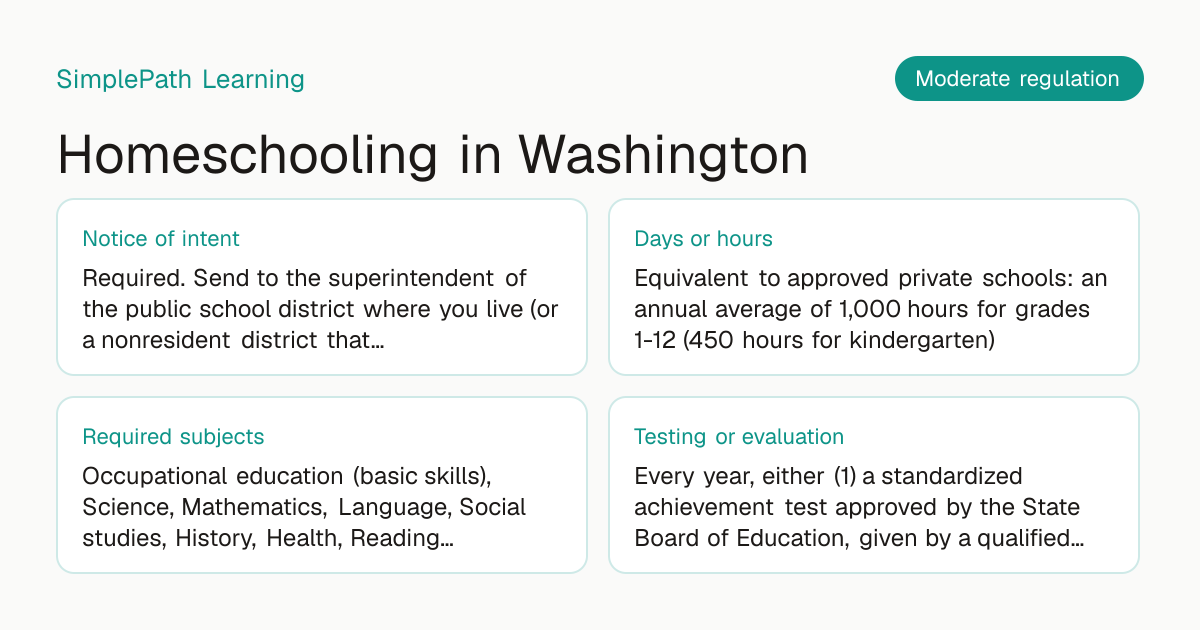
- Send to: the superintendent of the public school district where you live (or a nonresident district that accepts a transfer).
- When: by September 15 of each school year, or within two weeks of the start of any public school quarter, trimester, or semester.
- How often: annually.
- How: a signed declaration of intent in the format prescribed by OSPI, usually your district's own form.
- Instruction time
- Equivalent to approved private schools: an annual average of 1,000 hours for grades 1-12 (450 hours for kindergarten).
- Required subjects
- Occupational education (basic skills), Science, Mathematics, Language, Social studies, History, Health, Reading, Writing, Spelling, Appreciation of art and music.
- Records to keep
- Annual standardized test scores or written progress assessments (these become part of the child's permanent record).
- Immunization records.
- Other instructional records you keep.
- Copies of each year's declaration of intent.
- Testing / evaluation
- Every year, either (1) a standardized achievement test approved by the State Board of Education, given by a qualified person (test publishers can authorize parents as proctors), or (2) a written assessment of academic progress by a certificated person currently working in education. Results are kept by the parent and forwarded if the child later enrolls in a school. If the child isn't making reasonable progress, make a good-faith effort to fix it.
- Parent qualifications
- The parent must meet one of: (a) be supervised by a certificated person (joint planning, an average of one contact hour per week, and progress evaluation); (b) have earned 45 college-level quarter credits (or the semester equivalent); (c) have completed a course in home-based instruction at a postsecondary or vocational-technical institution; or (d) be deemed sufficiently qualified by the local school district superintendent.
Official form: OSPI Home-Based Instruction page (sample Declaration of Intent)
What the notice must include
- Each child's name and age.
- Whether a certificated person will supervise the instruction.
- Parent's signature.
Checklist
- File your declaration of intent with the school district: by September 15 each year, or within two weeks of the start of a public school term.
- Make sure you meet one parent qualification and keep proof: before you start.
- Give an approved standardized test or arrange an assessment by a certificated teacher: each year.
- Keep test results, assessments, and immunization records: ongoing.
Option 2: Approved private school extension program
Approved private school extension program · RCW 28A.195.010(4)
The child enrolls in a state-approved private school that runs an extension program, and the parent teaches at home under the supervision of a certificated employee of that school. Legally the child is a private school student, so the home-based instruction declaration and testing rules do not apply.
- Notice
- Not required.
- Instruction time
- Set by the private school (approved private schools must offer 180 days or the equivalent hours).
- Testing / evaluation
- No standardized test required; the school's certificated supervisor evaluates each student's progress.
- Parent qualifications
- Parent must be supervised by a certificated employee of the private school (planning together, an average of one contact hour per week each month, progress evaluation; no more than 30 students per supervisor).
Checklist
- Enroll with an approved private school that runs an extension program: before the school year starts.
- Meet with your certificated supervisor: an average of one hour per week, each month.
Leaving a public school
Filing a declaration of intent with your resident district is how you start home-based instruction; file it by September 15 or within two weeks of the start of a public school term. If your child later returns to public school, the district may give a standardized test and decides grade and course placement after reviewing your records.
Common questions about homeschooling in Washington
- Do I have to notify anyone to homeschool in Washington?
- Yes (for home-based instruction, the option most families use). You send notice to the superintendent of the public school district where you live (or a nonresident district that accepts a transfer), by September 15 of each school year, or within two weeks of the start of any public school quarter, trimester, or semester. How often: annually. A signed declaration of intent in the format prescribed by OSPI, usually your district's own form.
- What subjects do I have to teach in Washington?
- Washington requires: Occupational education (basic skills); Science; Mathematics; Language; Social studies; History; Health; Reading; Writing; Spelling; Appreciation of art and music.
- How many days or hours of homeschool does Washington require?
- Equivalent to approved private schools: an annual average of 1,000 hours for grades 1-12 (450 hours for kindergarten).
- Are standardized tests or evaluations required in Washington?
- Every year, either (1) a standardized achievement test approved by the State Board of Education, given by a qualified person (test publishers can authorize parents as proctors), or (2) a written assessment of academic progress by a certificated person currently working in education. Results are kept by the parent and forwarded if the child later enrolls in a school. If the child isn't making reasonable progress, make a good-faith effort to fix it.
- Do parents need a teaching certificate to homeschool in Washington?
- The parent must meet one of: (a) be supervised by a certificated person (joint planning, an average of one contact hour per week, and progress evaluation); (b) have earned 45 college-level quarter credits (or the semester equivalent); (c) have completed a course in home-based instruction at a postsecondary or vocational-technical institution; or (d) be deemed sufficiently qualified by the local school district superintendent.
- What records should I keep when homeschooling in Washington?
- Annual standardized test scores or written progress assessments (these become part of the child's permanent record); Immunization records; Other instructional records you keep; Copies of each year's declaration of intent.
Worth double-checking
- Compulsory attendance runs from age 8 to 18, so the declaration is required for children 8 and older. If a younger child is already enrolled in public school, ask the district how to withdraw formally, since enrolled younger children can be subject to attendance rules.
- OSPI's guidance booklet (the "Pink Book") is dated 2017, and its 1,000-hour figure comes from RCW 28A.150.220 as referenced there. Check with your district if hour rules have changed.
- The statute does not require you to submit proof of your qualification with the declaration, but some districts ask. Keep proof on hand.
Sources
- RCW 28A.200.010, Duties of parents providing home-based instruction.(official)
- RCW 28A.225.010, Compulsory attendance and home-based instruction.(official)
- RCW 28A.195.010, Private schools and extension programs.(official)
- OSPI: Home-Based Instruction.(official)
- OSPI: Washington State's Laws Regulating Home-Based Instruction ("Pink Book").(official)
This is a plain-language summary to help you get organized, not legal advice. Laws and forms change, so confirm the details with your state or school district before you file.